The Vitalist case for lymphatic support in spring — and why the plant already growing on your land is the one your body is asking for
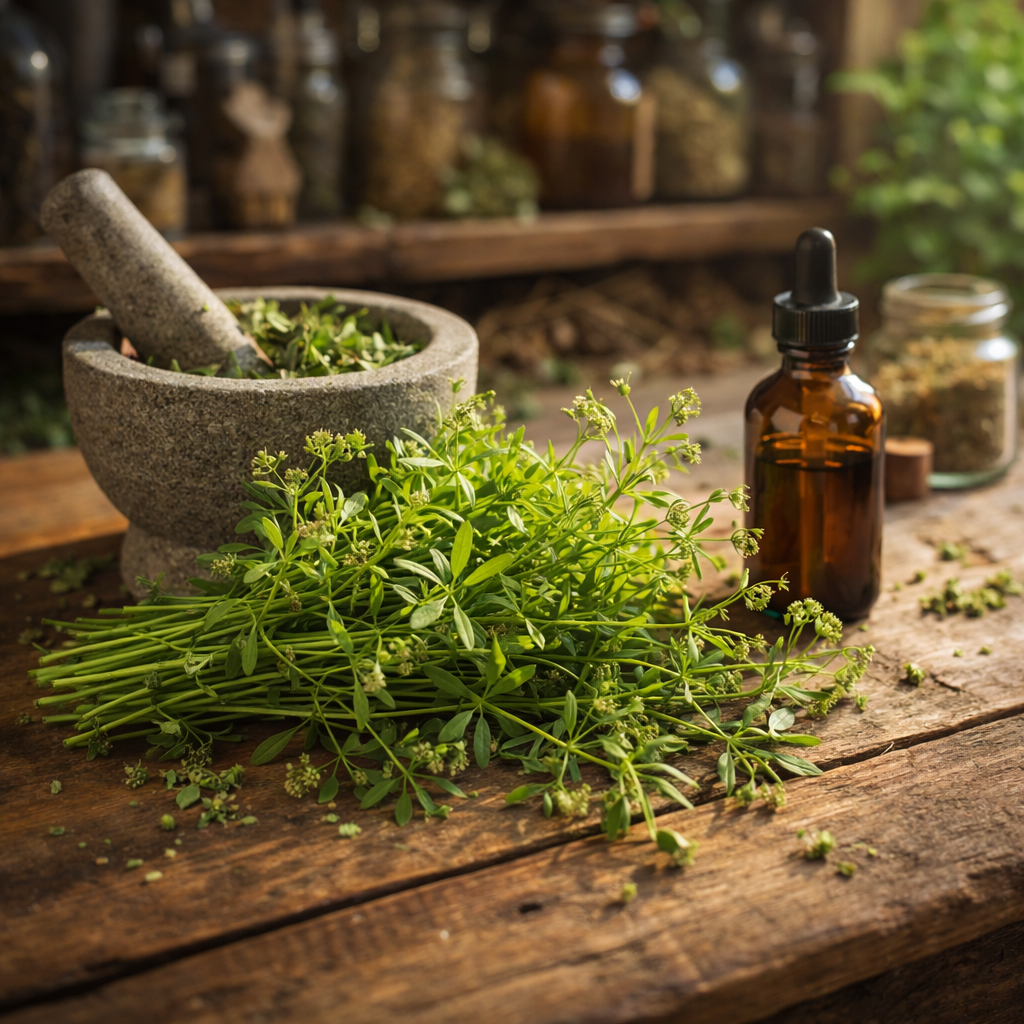
Right now, at P.A. Bowen Farmstead, Cleavers is emerging around the farm.
It comes up every year without being asked — soft, bright green, sprawling in the shaded margins of the fence lines and woodland edges, clambering over everything within reach with its tiny velcro hooks. Most people walk past it without a second glance. On a working farm in late March, there is always something more pressing demanding attention.
But I’ve learned to stop when Cleavers appears. Not because I planted it, not because I’m looking for it, but because the land is offering something precisely when the body most needs it. That’s not a coincidence. In the old herbal tradition, it never was.
What the Vitalist Tradition Actually Means by “Spring Cleanse”
The phrase “spring cleanse” has been co-opted by the wellness industry to the point of near-meaninglessness — a shorthand for juice fasts, elimination diets, and supplement protocols that may or may not have anything to do with what the body actually needs.
The Vitalist herbal tradition, which forms the foundation of my practice, has a more specific and useful framework. It understands health not as the absence of symptoms but as the free, unobstructed expression of vital force through a well-organized system. Disease, in this view, is not something that attacks us from outside — it is a disruption of pattern, a blockage of flow, a tissue state that has moved too far in one direction without correction.
Winter creates a recognizable pattern in the body. We move less. We eat more heavily. We spend more time in closed, recirculating air. The vital force contracts inward — appropriately, seasonally — and the result is what the old herbalists called damp stagnation: an accumulation of metabolic waste, sluggish lymphatic flow, a heaviness in the tissues that manifests as fatigue, skin congestion, a feeling of being waterlogged or stuck.
Spring’s job, physiologically, is to move that accumulation. The vital force begins to expand outward again. The body wants to drain, to open, to clear.
The question is whether it has the tools to do so efficiently — or whether it needs a hand.
The Lymphatic System: The Most Overlooked River in the Body
Most people understand the circulatory system. Blood moves through the heart, arteries, and veins in a closed loop, carrying oxygen and nutrients to the tissues and removing carbon dioxide.
The lymphatic system is less understood, and it does something different and equally essential. It is the body’s drainage network — a vast web of vessels and nodes that collects the fluid that leaks out of the capillaries into the tissues, filters it through the lymph nodes (where immune surveillance happens), and returns it to the bloodstream. It is how metabolic waste, cellular debris, pathogens, and excess fluid get cleared from the tissues.
Unlike the circulatory system, the lymphatic system has no pump. It moves through muscle contraction, breath, and movement. Which means that a sedentary winter — or a body that is constitutionally slow, cold, and damp — produces predictable lymphatic stagnation. The drainage backs up. The tissues become waterlogged. The immune nodes, doing their filtering work without adequate flow, become congested and sluggish.
The symptoms are familiar: swollen glands, persistent fatigue, dull skin, puffiness, that spring feeling of carrying more weight than you actually are.
This is not a metaphor. This is a tissue state.
And it has a specific remedy.
Cleavers: The Spring Medicine the Land Already Provides
Galium aparine — Cleavers, goosegrass, sticky willy — is one of the most reliable lymphatic plants in the Western materia medica. Cooling, gently diuretic, and deeply cleansing to the lymphatic channels, it embodies the fluid, flowing quality of the Water Element in its growth habit, its taste, and its action in the body.
Look at the plant itself. It grows in moist, shaded places — woodland edges, hedgerows, the cool margins of fields. It’s extraordinarily juicy, bending and twisting and clambering in patterns that look, honestly, like flowing water. Its flavor is green and mildly salty — the taste of minerals, of the ocean, of the body’s own fluids. And it is clingy, famously so, catching on fur and fabric with thousands of tiny hooks — a signature, in the old doctrine of correspondences, of its affinity for the tissues that “catch” and accumulate: the lymph nodes, the glands, the skin.
What Cleavers does in the body reflects all of this. It is a lymphagogue — it specifically stimulates lymphatic flow and drainage. It supports the lymph nodes, the tonsils and adenoids, the glandular tissues of the neck, chest, and pelvis. It is diuretic, moving the fluid that the lymphatics drain out through the kidneys. It supports the skin as an organ of elimination. And it does all of this gently — not forcefully, not dramatically, but with the quiet persistence of water finding its course.
The critical thing about Cleavers — the thing that shapes how we prepare it here — is that the fresh plant is the medicine. Upon drying, Cleavers loses the volatile compounds that carry much of its medicinal virtue. A dried Cleavers tincture is a pale shadow of what the fresh plant offers. This is one of the reasons I watch closely to harvest it the moment it is ready, at the peak of its spring vitality, and process it immediately.
Why Spagyric Preparation Changes What’s Possible
Most herbal tinctures are made by soaking the plant in alcohol and water, pressing out the liquid, and bottling it. This captures the alcohol and water-soluble compounds — a meaningful portion of the plant’s chemistry, and genuinely useful medicine.
What it leaves behind is significant.
The mineral Salts locked in the plant’s cellular structure — the purified mineral body of the plant, which carries its most fixed and physically grounding intelligence and provides a bioavailable mineral matrix the body recognizes — go into the compost with the spent marc. The volatile essential oils, the soul of the plant in alchemical terms, largely evaporate or degrade before the tincture is even bottled. A standard tincture is, in the language of the alchemical tradition, a partial extraction of a whole plant’s intelligence.
The spagyric process, rooted in the pharmacy of Paracelsus and practiced by physician-alchemists for centuries, works with the whole plant. The Three Principles — Sulfur (the soul, the essential oils), Mercury (the spirit, the alcohol and water-soluble extract), and Salt (the body, the purified mineral matrix from the calcined ash of the spent plant) — are each separated, purified, and then cohobated: reunited into a single medicine.
Nothing is discarded. The whole plant is present in the final preparation.
And because every step of this work — harvest, distillation, extraction, calcination, cohobation — is timed to the planetary day and hour of the plant’s celestial ruler, the completed medicine carries not only the biochemical intelligence of the plant but the archetypal force of its governing planet at the moment of its peak influence.
This is astral pharmacy. It is not a metaphor.
It is a practice.
A Plant from This Farm, for This Season
The Cleavers Spagyric Tincture in the Wort Botanicals apothecary is wildcrafted from P.A. Bowen Farmstead — from the same fence lines and woodland margins where it appears without invitation each spring, in land that has been actively regenerated for over a decade without pesticides, herbicides, or synthetic inputs.
It is harvested fresh, processed immediately, and prepared through the full spagyric process under appropriate planetary timing.
Spring is its moment. If your tissues are carrying winter’s accumulation — if you feel sluggish, waterlogged, heavy, or if your skin or glands are telling you something needs to move — this is the plant the season is offering.
It has been offering it for longer than herbalism has had a name.
These statements have not been evaluated by the Food and Drug Administration. This product is not intended to diagnose, treat, cure, or prevent any disease. The information in this post is offered for educational purposes within the Vitalist herbal tradition.