On Wild Rose, the intelligence of Venus, and a Mother’s Day medicine for the heart that knows how to protect itself
Before I add anything else to the batch, I add the thorns.
Three of them, drawn carefully from the cane, placed into the macerating vessel with the fresh blossoms. It is a small act and a deliberate one. The thorns are not incidental to the Rose — they are not a hazard to be worked around in the harvesting. They are part of the medicine. They are, in the language of the doctrine of signatures, the whole point.
Rose teaches two things simultaneously, and she has always taught them together: how to open fully, and how to hold a boundary. The velvety, fragrant, extravagantly generous blossom and the sharp, unambiguous thorn grow from the same cane. The same plant that offers beauty without reservation will draw blood if you approach carelessly. Three thorns in every batch, for the sanctity of that balance. For the understanding that a heart worth opening is also a heart worth protecting.
This is a Mother’s Day post. But it is not really about the holiday — it is about what the holiday is reaching toward and rarely fully grasps: the particular quality of love that is both fiercely generous and fiercely boundaried, that gives without losing itself, that remains open without becoming unguarded. Rose has been the medicine for that quality for as long as humans have been working with plants. She has not changed. We just forgot, for a while, what she was actually for.
The Plant at the Edge of the Pasture
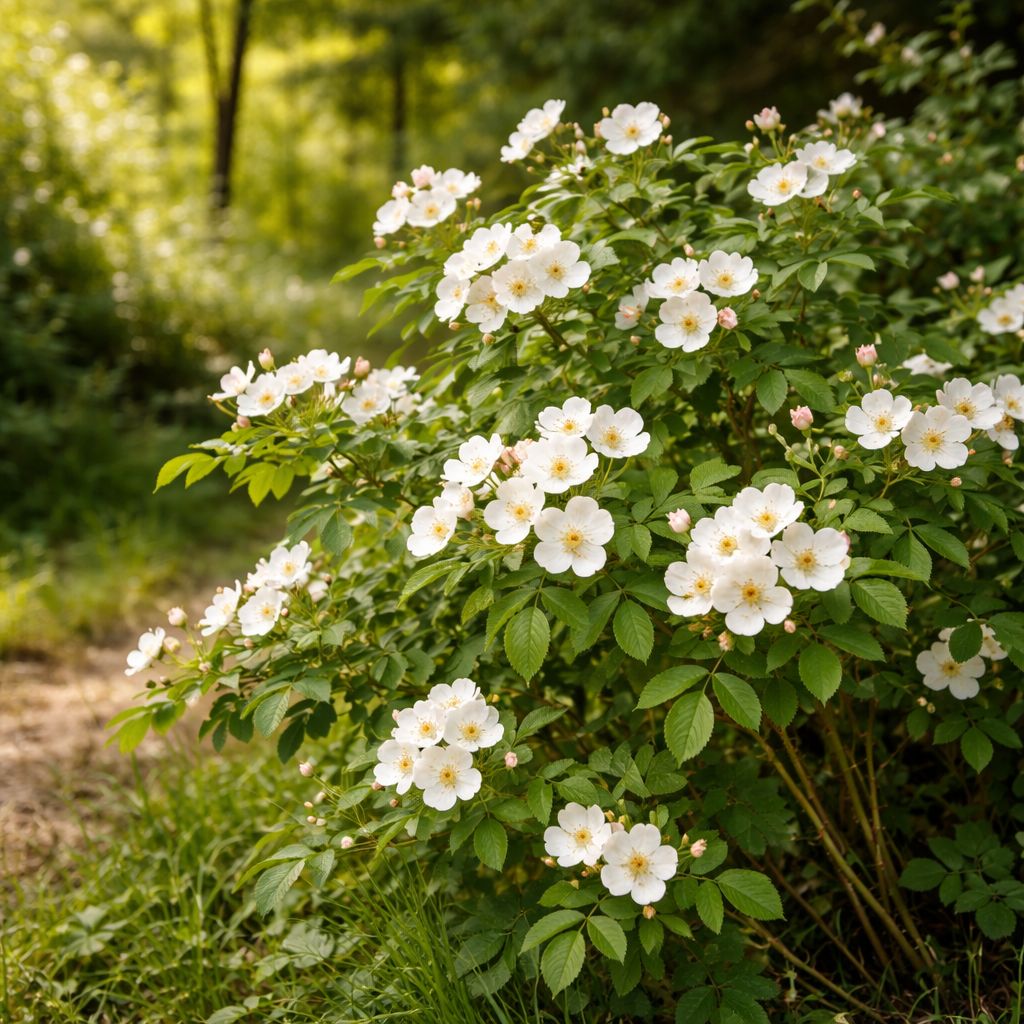
The Rose in the Wort Botanicals apothecary is Rosa multiflora — multiflora rose, which grows in exuberant, cascading thickets along the fence lines and woodland edges of P.A. Bowen Farmstead each May, erupting into thousands of small white blossoms that perfume the whole field on a warm afternoon.
It is, by the official designation of the Maryland Department of Natural Resources, an invasive species. Introduced from East Asia in the nineteenth century as a living fence and for wildlife habitat, it spread aggressively across the eastern United States and is now considered a management problem on farmland throughout the region.
I have thought about this a great deal, and I have arrived at a view that I think the Vitalist tradition would recognize: the plant that is most vigorously present in a landscape is often the plant that landscape most needs — or that the people living within it most need. Invasive vitality is still vitality. The medicinal intelligence of a plant is not diminished by the politics of its origin.
Multiflora rose belongs to the same genus as every rose the herbalists have worked with for centuries. Its blossoms carry the same cooling, astringent, heart-opening, nervine character as any wild rose. They arrive in their thousands in May, exactly when Venus is most present in the turning of the year, exactly when the heart needs what Rose has to offer. The Wild Rose Spagyric Tincture begins here – fresh multiflora blossoms at peak bloom, processed the same day the thorns go in.
Venus and the Architecture of the Heart
Rose is the most archetypal expression of Venus in the plant kingdom — a correspondence so deep and so consistent across traditions that it barely requires argument. Look at the plant and you see the planet: beauty, fragrance, softness, the tendency to grow in communal patches in relationship with one another, and the thorns that make it very clear that all of this openness has terms.
Venus, in the astrological and alchemical framework, rules the heart — not primarily as a physical pump, though she has jurisdiction there too, but as the center of love, relationship, grief, and the soul’s capacity for connection. She is the harmonizing principle, the force that draws two things together, the quality that makes genuine intimacy possible.
Physically, this translates into a set of specific affinities: the cardiovascular system and vasculature, the skin, the kidneys, and the tissues of the female reproductive system. Rose, as Venus’s most direct plant expression, works on all of these. She is cooling and gently astringent — she tones and tightens tissues that have become relaxed, inflamed, or leaking. She tightens the capillary beds. She reduces heat in the blood and vasculature. She soothes a nervous, irritable, or agitated heart. The rosehips, rich in vitamin C, strengthen the connective tissue that holds the whole cardiovascular architecture together.
But the physical action is only part of the picture. The more important dimension, and the one that makes Rose genuinely irreplaceable in the materia medica, is what she does at the level of the emotional and spiritual heart.
What Rose Actually Heals
There is a particular pattern that Rose addresses — one that shows up in many people and that the old herbalists understood clearly even if they didn’t always have language for it. It is the pattern of a heart that has been hurt enough times to stop fully opening. The person who keeps entering the same kind of relationship and cannot understand why. The one who has built walls so gradually and so skillfully that they no longer notice the walls are there. The one who gives freely to everyone else and cannot receive. The one whose heart has grown armored in the exact shape of an old wound.
Rose works on all of this — not by bypassing the wound, but by restoring the intelligence that was present before it. The intelligence that says: I can open fully and I can hold a boundary. These are not opposites. One without the other is the problem.
The thorn is not the opposite of the blossom. It is the blossom’s condition of possibility.
In the Vitalist tradition, this dual action — opening what has closed, strengthening what has become boundaryless — is Rose’s specific genius. She is cooling where there is heat and inflammation in the heart from old anger and resentment. She is tonifying where the heart has become so open that it can no longer distinguish its own feeling from everyone else’s. She helps integrate the lessons of difficult relationships so they can be released without being repeated. She teaches forgiveness — of the other, and of the self — not as a moral instruction but as a physical and energetic reality in the tissues.
This is what Venus, in her highest expression, does: she teaches us to love in a way that includes ourselves in the circle of that love.
The Wild Rose Spagyric Tincture and Why It Matters
The Wild Rose Spagyric Tincture is made from freshly harvested multiflora blossoms at peak bloom — when the volatile oils that carry Rose’s soul-quality are at their most concentrated and alive. Fresh plant preparation is essential here, as the delicate aromatic compounds that make Rose medicinally distinct begin to degrade from the moment of harvest.
Through the spagyric process, the Three Principles of the plant — the Sulfur (essential oils, the soul), the Mercury (the alcohol and water-soluble extract, the spirit), and the Salt (the purified mineral body from the calcined ash, the physical intelligence of the plant) — are separated, purified, and reunited into a single preparation that carries the whole plant’s intelligence. Nothing is discarded. The mineral Salts of Rose, which would be lost entirely in a standard tincture, are restored to the preparation and absorbed alongside the aromatic and biochemical fractions.
Every step of this work — harvest, distillation, extraction, calcination, cohobation — is timed to the day and hour of Venus, so that the archetypal force of the plant’s celestial ruler is concentrated into the medicine at its peak influence.
And the three thorns go in at the beginning, to remain through the entire maceration — present throughout every stage of the preparation, lending their sharp, clear, Martian intelligence to the soft Venusian medicine. Open heart. Clear boundary. Both, always, together.
This is the medicine May is asking for.
Wild Rose Spagyric Tincture is available in the Wort Botanicals apothecary.
Disclaimer
These statements have not been evaluated by the Food and Drug Administration. This product is not intended to diagnose, treat, cure, or prevent any disease. The information in this post is offered for educational purposes within the Vitalist herbal tradition.