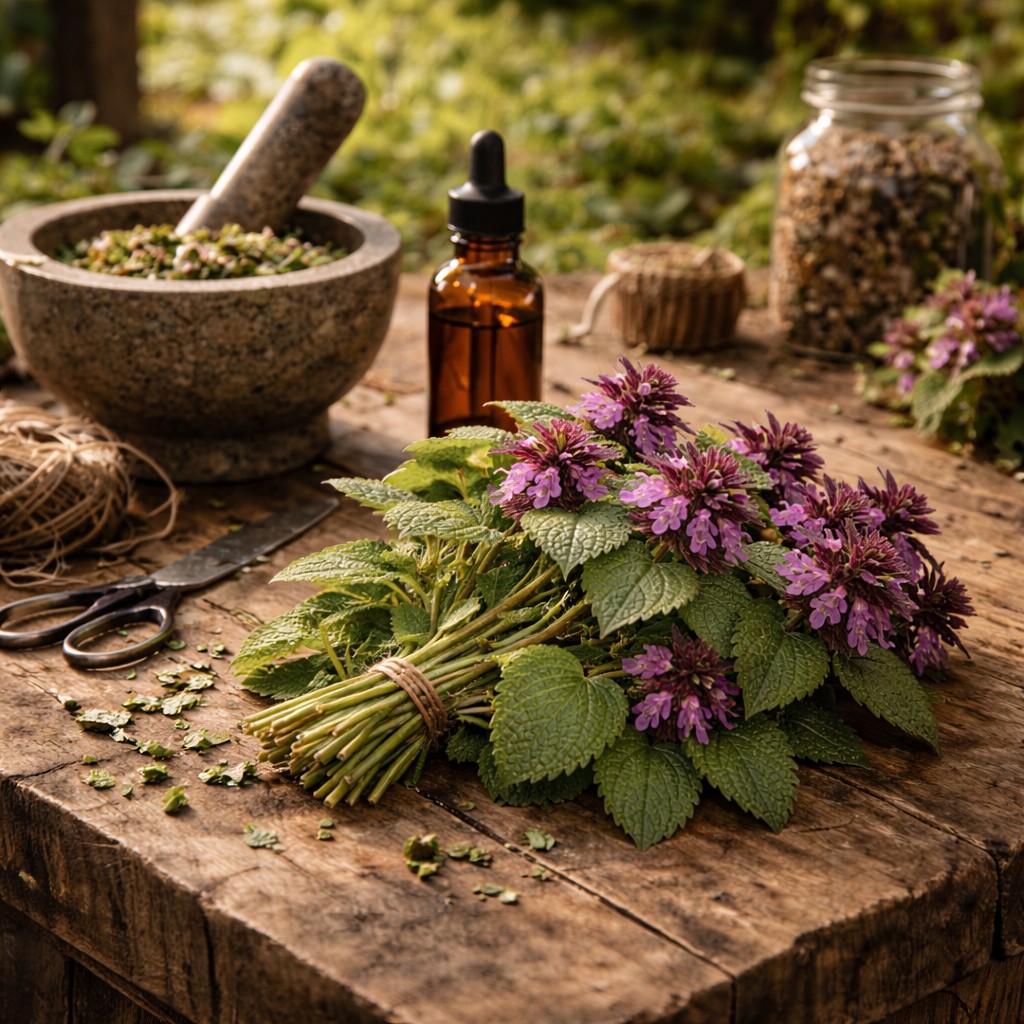
Purple Dead Nettle, spring allergies, and the medicine hiding in plain sight on the farm floor
It is purple, and it is everywhere.
Walk any field at P.A. Bowen Farmstead right now and you will find it carpeting the soil between the pasture grasses — low, dense, spreading in overlapping rosettes of soft hairy leaves, their upper tiers flushed a deep reddish-purple that catches the early April light in a way that is, if you stop and look, genuinely beautiful. Most people don’t stop and look. It reads as a weed, which in agricultural terms it largely is, and the eye passes over it on the way to something more obviously important.
This is a mistake the Vitalist tradition would recognize as characteristic: the most available medicine is often the least examined. The plant underfoot is the one the season is actually offering.
Lamium purpureum — Purple Dead Nettle — is one of the first plants to come alive in the Maryland spring. And its name contains a paradox worth sitting with.
Dead, and First to Live
The “nettle” in Purple Dead Nettle is a borrowed name — this plant is not a true nettle at all, and it does not sting. It belongs to the mint family, a gentle and nourishing herb, and the “dead” in its name refers precisely to the absence of that sting. Dead nettle: the nettle that cannot hurt you.
But look at what it does in practice. While the true nettles are still underground, while most of the pasture is still brown from winter, while the land is still technically between seasons — Purple Dead Nettle is already here. Fully present, fully purple, spreading vigorously across every disturbed and open piece of ground it can reach. It is among the first flowering plants of the year, offering pollen to early bees before almost anything else is available.
The plant named for what it lacks — the sting, the danger, the Martian edge — turns out to be the one with the most vital force in the lean weeks of early spring.
The medicine that meets you gently, that does not announce itself with drama or intensity, that simply appears in abundance exactly where and when it is needed — that is often the medicine most worth paying attention to.
What the Plant Is Actually Doing
In the Vitalist framework, every plant has a tissue state affinity — a characteristic pattern of imbalance that it addresses most directly. Purple Dead Nettle’s primary affinities are for conditions of heat, inflammation, and immune hyperreactivity — patterns that accumulate through winter and begin to express themselves as the body wakes up in spring.
It is mildly astringent, which means it tones and tightens tissues that have become relaxed, leaky, or inflamed — tightening the mucous membranes that line the respiratory tract, firming up the tissue integrity that a season of indoor air and reduced circulation tends to erode. It is anti-inflammatory, gently cooling the excess heat that expresses itself in spring as congestion, irritation, and reactivity. And it has a traditional role in European folk medicine as a blood cleanser and immune modulator — a spring tonic in the oldest sense of the term, helping the body shift modes from the contracted, inward orientation of winter to the open, outward vitality of the growing season.
The purple-red coloration of its upper leaves is itself a signature: in the alchemical doctrine of correspondences, red and purple tones in plants indicate an affinity for the blood and immune system, a relationship to the Mars-ruled processes of inflammation, immune activation, and the body’s response to challenge. Purple Dead Nettle presents this signature in abundance — and then meets it with cooling, astringent, anti-inflammatory action. The plant carries the signature of the problem it addresses. This is not unusual in the materia medica. It is the rule.
The Allergy Question
Spring allergies — the itching eyes, the runny nose, the sneezing, the particular exhaustion of a body that is treating the air itself as a threat — are, in Vitalist terms, a pattern of heat and hyperreactivity in the mucous membranes and lymphatic tissues of the upper respiratory system. The body has become sensitized, its responses calibrated too high, its boundaries between self and environment poorly established. The result is inflammation at the surfaces: the eyes, the sinuses, the upper respiratory tract.
This is precisely the tissue state Purple Dead Nettle addresses.
Its astringent action tightens and tones the leaky, overreactive mucous membranes that produce the characteristic runny nose and watery eyes. Its anti-inflammatory properties cool the heat in the inflamed tissues. Its immune-modulating character — neither aggressively stimulating like Echinacea nor suppressing like pharmaceutical antihistamines, but gently regulating — helps recalibrate the body’s reactivity toward a more measured response.
There is something additionally elegant about the timing. Spring allergies are triggered by the same phenomenon that appears when Purple Dead Nettle blooms: the arrival of pollen. The plant is in its fullest medicinal vitality at the exact moment the body needs what it offers. The old herbalists called this providential. It is at minimum a remarkable coincidence, and one worth taking seriously.
It is also worth noting what Purple Dead Nettle is not. It is not a quick-acting pharmaceutical suppression of symptoms. It works with the body’s intelligence rather than overriding it — gradually supporting the tissue integrity and immune regulation that underlie the reactive pattern, rather than blocking the histamine response downstream. This means it is best employed as a daily tonic through the allergy season rather than as an acute rescue remedy for a bad symptom day. Consistent, gentle support. The plant’s way.
A Plant from These Fields, for This Season
The Purple Dead Nettle in the Wort Botanicals apothecary is wildcrafted from the fields of P.A. Bowen Farmstead — from the same purple-carpeted ground I walk every morning to the milking parlor, in soil that has been actively regenerated for over a decade without pesticides, herbicides, or synthetic inputs. It is harvested fresh at peak vitality and processed immediately, preserving the living intelligence of the plant at the height of its spring expression.
Through the spagyric process, the Three Philosophical Principles — Sulfur, Mercury, and Salt — of Purple Dead Nettle are separated, purified, and cohobated under appropriate planetary timing. The mineral Salts of the plant, locked in its cellular structure and lost entirely in a standard tincture, are restored to the preparation, making available the full-spectrum intelligence of a plant that the body recognizes as food as much as medicine.
This is a humble plant with an unflattering name, carpeting ground that most people walk across without a second thought. But the season knows what it is doing. The medicine that appears in the greatest abundance is often the medicine most needed.
Purple Dead Nettle is here. It has been here for weeks already. It will be gone by the time summer arrives.
The window, as with all spring medicines, is now.
Disclaimer
These statements have not been evaluated by the Food and Drug Administration. This product is not intended to diagnose, treat, cure, or prevent any disease. The information in this post is offered for educational purposes within the Vitalist herbal tradition.