Japanese Stiltgrass and the Question Nobody’s Asking
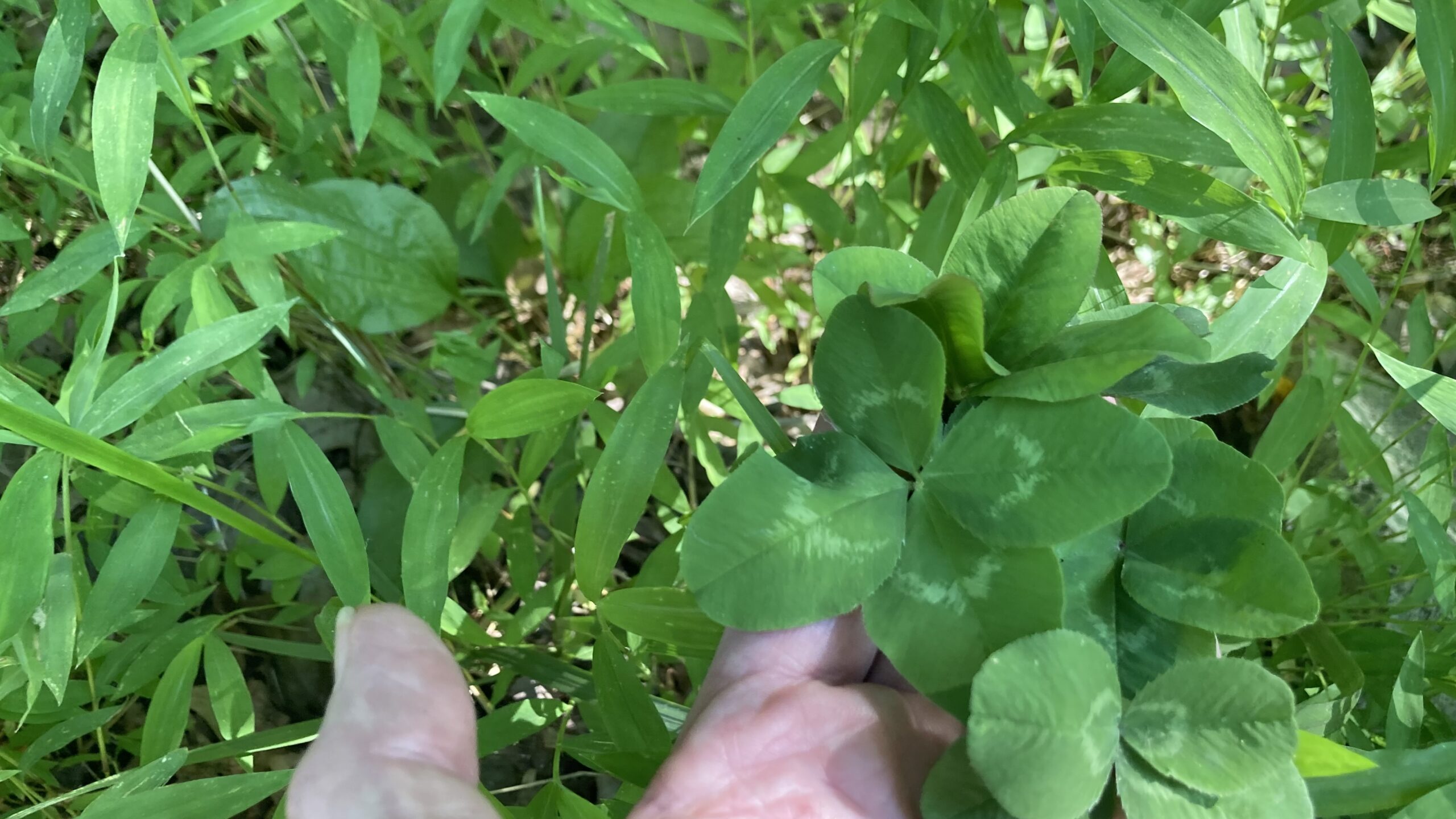
A few days ago, I was showing my friend Innes a photograph — a small cluster of four-leaf clovers I’d found among the farm’s pasture edges, pressed together like a secret. She leaned in, looking past them at the background of the image, at a fringe of delicate, pale-green grass with a distinctive silver stripe running down each leaf.
“Ooo, I see Japanese stiltgrass – we have lots of that in our yard. Does it have any medicinal benefits?” she asked.
Japanese stiltgrass, Microstegium vimineum. I didn’t know. But I told her I’d find out.
And I found — almost nothing. Every article I turned up was concerned with the same thing: how aggressive it was, how many states had listed it as a noxious weed, how to pull it, spray it, burn it, or starve it out. Invasion biology had filed its verdict, and the verdict was unanimous: this plant is a problem. Get rid of it.
But there was one piece that said something different. It asked a different question. Not how do we get rid of it, but why is it here in the first place?
That’s the question I want to sit with.
Microstegium vimineum arrived in North America around 1919, tucked into porcelain shipments from China as packing material, and found itself quietly at home in Tennessee. A small, shade-tolerant annual grass — resembling a miniature bamboo — with pale lance-shaped leaves and that silver midrib that caught my friend’s eye. It doesn’t announce itself loudly. It spreads without fanfare, seeds profusely, and dies back in autumn to a tawny, straw-like thatch.
Over a century later, it has spread across 26 states and become one of the most uniformly condemned plants in the mid-Atlantic and southeastern landscape.
We have had it on the farm for years. I have never noticed it being especially aggressive, especially threatening, especially anything. It grows quietly at the edge of things — forest margins, where the mowed pasture gives way to the young woodland — and I have always walked past it with a kind of vague acknowledgment, the way you acknowledge a neighbor you don’t quite know yet.
Now I’m wondering if I should have paid more attention.
A Pioneer’s Portfolio
Here is what I have come to understand about this plant, after setting aside everything written in the key of alarm: Microstegium doesn’t invade healthy, biologically diverse ecosystems. It appears primarily in recovering woodland — places where agriculture once worked the soil hard, where years of plowing and overgrazing and compaction destroyed the native seed bank that would otherwise dictate what grows. When the seed bank is gone, nothing programmed by the old ecology reliably comes up. What grows is whatever arrives on the wind or in the gut of a passing bird: young tulip poplars, wild cherries, multiflora rose — and yes, stiltgrass, carried in on a deer’s coat or by the slow work of floodwaters through a drainage.
In other words, Microstegium is not the cause of the disturbance. It is among the first visible clues that nature is beginning to respond to one.
Research has borne this out. A long-term study found that after eight years of observation, the initial suppressive effects of stiltgrass on native species had substantially diminished, with succession eventually restoring native plant dominance — whether through fire management or simply through time. The evidence is clear: stiltgrass declines as succession advances. It is an annual, and annuals are, almost by definition, pioneers. Their role is to arrive first, do their work, and step aside.
What work? More than most people realize.
By holding soil moisture through the long, dry summer months, stiltgrass moderates pH toward the neutral range — and circumneutral soils are characteristically more fertile. Research has found that soils beneath stiltgrass are elevated in phosphorus and nitrates, which the plant processes in large quantities. It forms a living mulch over bare and compacted earth, protecting against oxidation and erosion. Come autumn, its dried stems fall into a straw-like thatch that holds temperature and moisture for whatever is trying to emerge beneath it.
I have seen this on the farm. Jack-in-the-pulpit (Arisaema triphyllum) — a plant that requires cool, boggy, shaded woodland conditions — sometimes turns up in unexpectedly exposed places, sheltered by the previous year’s stiltgrass mulch. The grass isn’t displacing the native plant. It’s sheltering it. Provisionally replicating a forest floor microclimate until the forest is ready to provide one itself.
This is not the profile of an invader. This is the profile of a nurse plant.
The Wrong Framework
I have thought for a long time about the invasive species model, and I hold it with a kind of philosophical suspicion. Not because the ecological disruptions it describes are never real — they can be, particularly on islands or in other systems isolated from ongoing evolutionary exchange — but because the framework so reliably deflects our attention from the actual cause.
Where do so-called invasive species flourish most aggressively? In disturbed landscapes. In land that has been plowed, compacted, chemically treated, stripped of its native seed bank, fragmented, dewatered, paved over. In land that was already broken before the plant in question arrived. The invasive species exists primarily as a symptom. The framework treats it as the disease.
Meanwhile, the single most ecologically disruptive organism in the history of this planet is apparently not worth listing. Homo sapiens doesn’t even appear in the Global Invasive Species Database — not in the top one hundred, not at all. That omission is not accidental, and what it tells us is worth contemplating.
There is also the question of time. Every dominating organism eventually drowns in its own success and becomes substrate for the next succession. This is one of the oldest laws in ecology, and stiltgrass is not exempt from it (nor are humans). The long-term studies confirm what patient observation suggests: given time and the gradual return of perennial diversity, stiltgrass yields. It does its work and it steps back.
We could call that invasive. Or we could call it a healer that does not overstay its welcome.
The question is not: how do we kill it?
The question is: what is it trying to repair?
A Pattern Worth Noticing
A few weeks ago I completed a beautiful spagyric tincture of Japanese Knotweed (Reynoutria japonica) — another plant that has been met with near-universal alarm in the Western landscape. Eradication programs have been launched against it. Herbicide campaigns. Dedicated removal crews. And it turns out that this same plant, when attended to with curiosity rather than combat, carries some of the most potent medicine available for the kinds of deep, chronic, biofilm-supported infections that conventional medicine struggles with — rich in resveratrol and stilbenoids, with documented activity against some of the most persistent microbial patterns of our era.
The invasive became the indispensable. It just required someone to ask: what does this plant actually do?
I am not making the same claim for Microstegium – not yet anyway. The honest answer is… I don’t know what formal medicinal virtues it carries. The ethnobotanical record from its Asian homeland — where it has grown for millennia alongside its human neighbors — appears to be largely silent on the subject. That silence may simply mean nobody thought to look, or that in the landscapes where it is native, it is too humble, too common, too much a part of the background to have attracted the herbalist’s attention in the way that more dramatic plants do.
But I notice things.
The One Thread to Pull
Microstegium vimineum is a plant of exceptionally high silica content. This is, in fact, why deer won’t browse it — the foliage is too coarse on the palate. Silica accumulates in the cellular structure of grasses as a physical defense, and it also has something interesting to say medicinally.
The most studied silica-bearing plant in the Western herbal tradition is Horsetail (Equisetum arvense) — a plant that has been used for centuries to support connective tissue, strengthen structural tissues, and provide the bio-available silicon that bones, hair, nails, and the integrity of the vessel walls depend upon. In the traditional scheme, silicaceous plants carry an affinity for structure, for boundaries, for the hard architecture of the living body. This is distinctly Saturn.
The grass family as a whole — Poaceae — contains extraordinary nutritional intelligence. The grains, the sugarcanes, the bamboos, the pasture grasses that have sustained animal and human life across millennia. To dismiss the medicinal potential of an entire plant family on the grounds that one particular species hasn’t been formally studied is not a conclusion. It is an oversight waiting to be corrected.
There is also this: as stiltgrass decomposes, its silica-rich tissues break down into the soil and create substrate for more nutritious plants in subsequent stages of succession. Even in death and decomposition, Microstegium is contributing to the fertility of what comes after it. The medicine is not only in what a plant does for the body. Sometimes it is in what a plant does for the land.
The medicinal intelligence of a plant is not diminished by the politics of its origin.
Brian Wort

My friend asked me a question I couldn’t answer. That happens, and when it does, I get excited because I have learned to treat it as a doorway rather than a wall.
The question was simple: does this have any medicinal value?
The real question underneath it is older and harder: what is this plant here for?
I don’t believe the living world scatters plants randomly. I think every plant that persists in a place — that seeds and roots and returns year after year — is, in some sense, responding to something that place needs. A deficit in the soil. A wound in the ecology. A repair that has to begin somewhere, with something, however humble.
Sometimes what heals the land can heal us too. We just have to be willing to ask.
I am watching the stiltgrass at the farm edges more carefully now. And I am listening — because Microstegium vimineum is a plant whose story, as far as Western herbal medicine is concerned, is still unwritten. That’s not a problem. That’s an invitation.
Disclaimer
These statements have not been evaluated by the Food and Drug Administration. This product is not intended to diagnose, treat, cure, or prevent any disease. The information in this post is offered for educational purposes within the Vitalist herbal tradition.