On sacred timing, the Dogwood blossom, and a flower essence prepared at the threshold of Good Friday
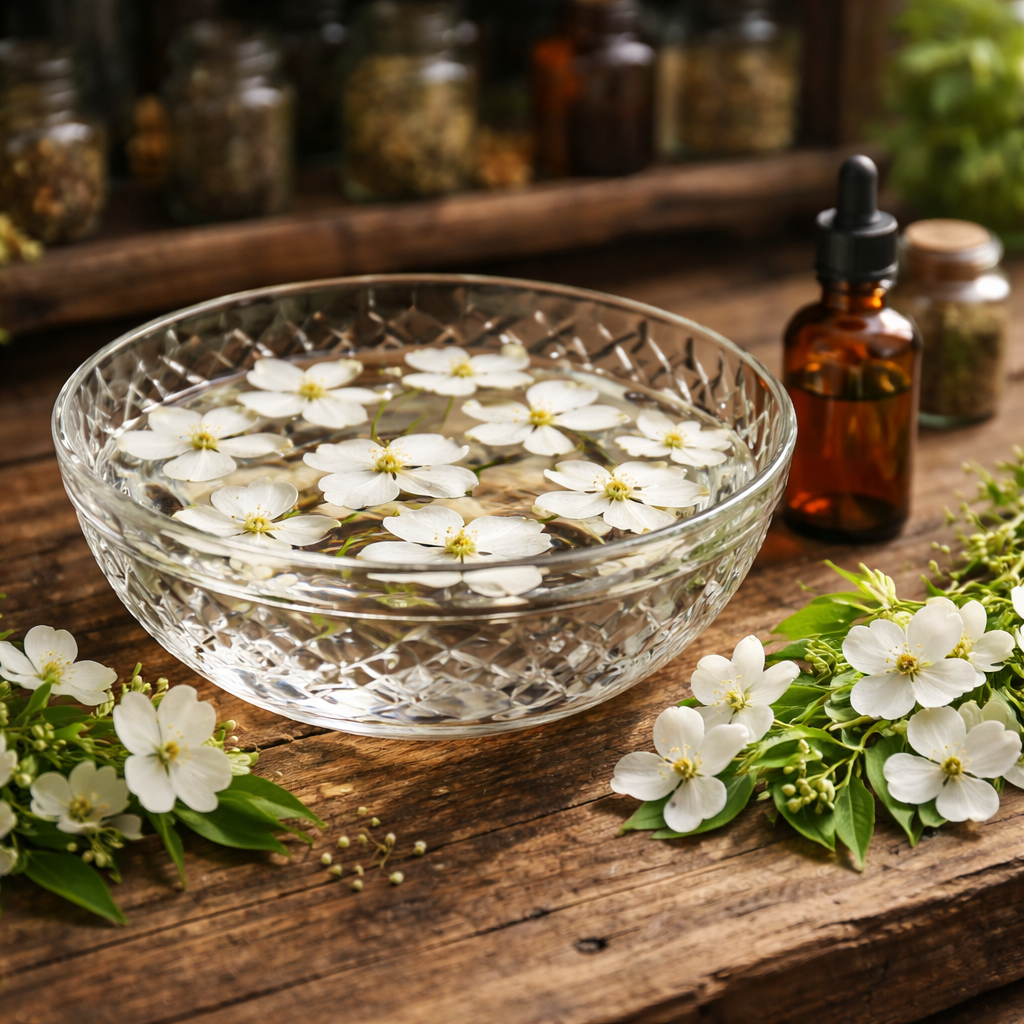
The crystal bowl went under the tree before the sun was fully up.
That is the requirement of the sun-infusion method — that the blossoms float in the water while the light is still arriving, while the day is still becoming itself. On any other morning of the year, this would be a quiet act of attention, a practitioner meeting a plant at its hour. On Good Friday, it is something else. The stillness of that particular morning has a quality to it that is difficult to name and impossible to mistake. The world is holding something. You feel it before you remember why.
The Dogwood at the edge of the woodland was in full bloom — explosively, almost impossibly white against the still-bare trees behind it, the way it always is in early Maryland spring, before the canopy has filled in enough to compete with it. I stood there for a moment before setting anything down. Some mornings ask for that.
Then I set the crystal bowl in the growing sunlight beneath the outer branches, floated the freshly plucked blossoms on the surface of the distilled rainwater, and stepped back. The medicine was already at work. All I had done was show up at the right time.
Why Timing Is Not a Detail
There is a version of herbalism that treats preparation as pure chemistry — a matter of extraction ratios, solvent percentages, standardized constituents. In that framework, the day you make a tincture is irrelevant. What matters is the procedure.
The tradition I work in holds a different view, and it is not a mystical one — or rather, it is mystical in the oldest and most precise sense of the word: rooted in the understanding that the qualities of time are as real as the qualities of matter, and that what you make on a given day bears the stamp of that day.
This is the doctrine of astral pharmacy, practiced by the physician-alchemists of the Western tradition for centuries. Its logic is the logic of as above, so below — the recognition that the same archetypal forces that pattern the stars also pattern the hours, the days, the seasons, and the medicines made within them. Paracelsus wrote that a physician who did not understand astronomy was only half a physician. He meant it literally.
In practice, this means that every preparation in this apothecary is timed. Every spagyric tincture is harvested, distilled, extracted, calcined, and cohobated on the planetary day and hour corresponding to that plant’s celestial ruler. The medicine is not merely extracted from the plant — it is harvested from a specific moment in time, and that moment is chosen because the force most aligned with the plant’s nature is at its peak influence.
Flower essences take this principle further, and in a different direction. Whereas spagyric work operates across multiple sessions over days, weeks, or even months, a flower essence is made in a single morning — the blossom floating in water in full sunlight, at the precise moment of its fullest opening. The preparation is not a distillation or an extraction. It is an impression. The soul-quality of the flower at the apex of its expression is received by the water, and the water holds it.
Which means the day of preparation is not incidental. It is the whole medicine.
The Tree and Its Signature
Cornus florida — the Flowering Dogwood — is one of the defining presences of the eastern American woodland in spring. It blooms before the leaves, which means it blooms into emptiness, into the bare gray lattice of the still-sleeping forest, a sudden white explosion that has no competition and needs none. There is something almost audacious about it. Something that insists.
Look more closely at the blossoms — or rather, at what appear to be the blossoms. The four white structures surrounding the small central cluster of true flowers are not petals. They are bracts: modified leaves that have become, over the long evolution of this tree, more flowerlike than the flowers themselves. Each bract ends in a notch, as if marked. In the Christian tradition, this shape has been read for centuries as a cross — the four bracts forming the arms, the notches recalling the wounds of the nails, the reddish center echoing what was shed there. Whether you hold that tradition or not, the signature is present in the plant: a form that bears a cross, blooming at its most brilliant in the days surrounding the Christian Passion.
The doctrine of signatures — the ancient principle that a plant’s form, color, and habitat reveal its medicinal character — does not ask us to take these correspondences literally. It asks us to take them seriously. The Dogwood does not bloom in crosses because it is commemorating an event. It blooms in crosses because that is its nature, and its nature resonates with a certain quality of experience — the quality of threshold, of sacrifice, of something ending at the precise moment something else becomes possible.
Good Friday and the Medicine Made in Darkness
Good Friday is the most difficult day in the Christian sacred calendar to sit with. It is not a day of triumph or consolation. It is the day the light goes out — or appears to. The day the story arrives at its most impossible point. Theologically and experientially, it is the moment of maximum darkness before the turn that cannot yet be seen.
In the alchemical tradition, sacred days are understood to carry a distinct quality of cosmic force — the same way planetary hours carry the concentrated influence of their governing planet, a day like Good Friday carries something that cannot be found on ordinary days. Not because of doctrine, but because the human attention that has been focused on that day for two thousand years — the grief, the surrender, the willingness to go to the darkest place and not look away — has given that day a real and tangible quality. Sacred days are not arbitrary. They are accumulated.
The medicine prepared on Good Friday is stamped with that quality. What is made at the moment of greatest darkness carries within it the seed of what follows — not as a promise, but as a potential. The transformation encoded in the Passion story is not the resurrection alone. It is the full arc: the willingness to descend, the passage through what cannot be bypassed, and the emergence that only becomes possible because the descent was completed.
A flower essence made on that morning, from a tree whose very form is a cross, carries that full arc within it.
What This Essence Is For
Flower essences do not work on the physical body. They work on the subtle, energetic, and soul dimensions of the person — the emotional patterns, the deep-seated orientations of the spirit, the places where something has become fixed or stuck or closed that was meant to remain in movement.
The Dogwood Blossom Flower Essence is for those who are in the middle of something they did not choose and cannot rush. A loss. A dissolution. The slow collapse of a structure that no longer fits — a relationship, a vocation, an understanding of who you are. The kind of passage that cannot be circumvented by insight or intention, only moved through with presence.
What the essence does, in the language of the Vitalist tradition, is not force or accelerate. It illuminates. It brings the quality of the Dogwood’s nature — that willingness to bloom brilliantly, right at the threshold, in the cold and the bare and the not-yet — into the interior landscape of the person working with it. It does not take the darkness away. It makes it possible to be in the darkness without being extinguished by it.
The sun-infusion method matters here because it mirrors the action of the essence itself: light received by water, held gently, preserved. There is no heat, no force, no extraction. Only receptivity at the right moment.
That is the practice. That is what was in the bowl under the tree on Good Friday morning, while the world was still holding what it was holding, and the blossoms were doing what they do.
Dogwood Blossom Flower Essence is available in the Wort Botanicals apothecary.
These statements have not been evaluated by the Food and Drug Administration. This product is not intended to diagnose, treat, cure, or prevent any disease. Flower essences are offered as vibrational medicines for the soul’s journey, within the tradition of flower essence therapy as established by Dr. Edward Bach and developed by practitioners in the decades since..